Peter Tork, The Monkees and “Shades of Gray”

Saddened to hear the news that Peter Tork of the Monkees has died. Since starting this project, where I journey back in time reminiscing about the music of my youth, it has become apparent that it all started for me at around the age of six, which in my case was 1966. Coincidentally that was when the Monkees first made an appearance on our black and white television screens, and although I was aware of other artists who popped up on the prime time slots watched by my mum and dad, the Monkees belonged to me.

thRXPD4TMH
Peter Tork, RIP

I am sorry Peter, but the Monkee I was most infatuated with at age six, was Davy Jones, and one of the first posts I published on this blog was about him (link here). But you Peter, were the Howard Donald of the Monkees. You weren’t the cutest or the zaniest; you had a bowl haircut, didn’t wear a hat and were the oldest of the group; but like Howard of Take That fame, in time you became my favourite Monkee.

Despite being an accomplished Greenwich Village folk musician when you got the role in the sitcom that would change your life, at the start you weren’t even allowed to play your own instruments. That would change with time however, and you became the man in charge of keyboards and bass. You didn’t get the role of star vocalist very often, but here is a lovely song where you did share lead vocals with Davy Jones. Shades of Gray (American spelling of grey) is also very apt for this post, as it starts off with the lines:

When the world and I were young
Just yesterday
Life was such a simple game
A child could play, (yes, that would have been 1966 for me)

and ends with the verse:

But today there is no day or night
Today there is no dark or light
Today there is no black or white
Only shades of gray, (oh yes, as our politicians can testify, how complicated life has become in 2019)

Shades of Gray was another of those great ’60s songs written by Barry Mann and Cynthia Weil. It was recorded by The Monkees for their 1967 album “Headquarters” and was the first song on which the group played all their own instruments.

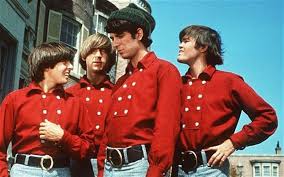
But here is another great song from that era, the clip this time in colour, where the boys are wearing those iconic dark red shirts with the silver buttons. Of course back in 1966 we wouldn’t have known their shirts were red, would we, because we watched telly in black and white? But here is where I beg to differ. Our local football team, Aberdeen FC played in red, and whenever their matches were aired on television, the grey of their shirts matched the grey of the Monkees shirts. At age six I was obviously pretty good at working out what the colours should be, based on the shades of grey of the various team shirts. Living in a football loving household meant you developed all sorts of useful skills of a televisual nature.

Last Train To Clarksville by the Monkees:

Tommy Boyce and Bobby Hart wrote Last Train To Clarksville as a protest to the Vietnam War but had to keep that quiet in order to get it recorded. It is about a guy who gets drafted, and the train is taking him to the army base. He knows he may die in Vietnam, and at the end of the song he states, “I don’t know if I’m ever coming home.”

Peter Tork was one of the many artists of my youth to have been born in 1942, right in the middle of a World War, but yet a vintage year for the birth of future musical legends (what was that all about?). Unlike in 2016, when I started this blog, I haven’t actually written any tributes so far this year. Cross fingers there won’t be too many more, but considering the span of time I write about here, I suspect there will be. A great chance to revisit the music though, and I have a feeling that a lot of people who had all but forgotten about the Monkees, might have had a sneaky peek at an old clip of Daydream Believer yesterday – I know I did.
the monkeesUntil next time…

Shades of Gray Lyrics
(Song by Barry Mann and Cynthia Weil)

When the world and I were young
Just yesterday
Life was such a simple game
A child could play
It was easy then to tell right from wrong
Easy then to tell weak from strong
When a man should stand and fight
Or just go along

But today there is no day or night
Today there is no dark or light
Today there is no black or white
Only shades of gray

I remember when the answers seemed so clear
We had never lived with doubt or tasted fear
It was easy then to tell truth from lies
Selling out from compromise
Who to love and who to hate
The foolish from the wise

But today there is no day or night
Today there is no dark or light
Today there is no black or white
Only shades of gray

It was easy then to know what was fair
When to keep and when to share
How much to protect your heart
And how much to care

But today there is no day or night
Today there is no dark or light
Today there is no black or white
Only shades of gray
Only shades of gray

Willie Nelson, Moonlight in Vermont and Snow (Or Rather, the Lack of It)

Since discovering that all full moons have a name (given to them by the Native Americans who kept track of the months by the lunar calendar), I have written about each one as they appear in our skies. To accompany the post I always include one of the numerous songs that have been written about the moon and its many foibles.

I can scarcely believe it’s been four weeks since my last “moon post”. What is it with time? The older you get, the faster it seems to whizz by. I heard a great quote recently, where the phenomena was described as such: “Life is like a roll of toilet paper. The closer it gets to the end, the faster it goes.” How apt I thought.

Anyway, it is now nearly a month since we witnessed (or didn’t in my case) January’s lunar eclipse. This month, we should witness the Snow Moon on the night of the 19th February. I had intended to use the alternate names for the full moon this year, however last year, because of the 29 and a half day lunar cycle, we didn’t have a full moon in February at all. Instead, we ended up with two Blue Moons (a second full moon in the same calendar month) on either side. As I said at the start of this series, no two years will ever be the same.

snow m 2
The Snow Moon

But this is a moon post, so what song to feature this time. Well, getting back to that old chestnut time, or rather the lack of it this week, I am going to cheat a little and include a song that has previously been included as part of another series. I started out with great gusto on my American Odyssey in Song in early 2017, but floundered last year upon reaching little Delaware. There was only one obvious contender for that state, but I didn’t want to write about it, and that was that. Fortunately, George has picked up the mantle, and is manfully making his way round the 50 states over at CC’s place. Lets hope, unlike me, he doesn’t flounder when he reaches Delaware.

This is a very roundabout way of saying, the song I’m going to include to accompany the Snow Moon, is Moonlight in Vermont by Willie Nelson. I didn’t actually know the song until it was suggested as a contender for my series, and after listening to several versions (it has been recorded by just about everyone), the one I warmed too most was Willie’s version.

Moonlight in Vermont by Willie Nelson:

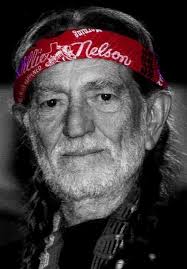
Willie Nelson is of course one of the greats of country music, and when he decided to record an album of standards called Stardust, in 1978, he wanted the song to be on it. It is considered the unofficial state song of Vermont and is frequently played as the “first dance song” at wedding receptions. It was written in 1944 by John Blackburn and Karl Suessdorf, and is unusual in that the lyrics take the form of a haiku.

imagesW4IKA692
Willie Nelson

And again, I’m going to share this heart-warming little story connecting my grandfather to the state of Vermont and to the song. Whilst doing a bit of research for my “Vermont post” back in 2017, I made an interesting discovery. The blacksmith and inventor John Deere was born there, and he was the man responsible for giving us much of the agricultural and construction equipment still used today, specifically the large steel plough.

My grandfather was not the “lineman for the county”, but he was the “roads supervisor for the county” back in the 1950s. The climate and landscape of the North of Scotland would have been similar in many ways to that of Vermont, so thank goodness for the large snow plough attachments that came across from America just at the time my grandfather was responsible for keeping the often snowbound, highways and byways of Aberdeenshire open. Back then, before the days of television, the wireless was the main form of home entertainment, and I feel sure my grandfather might well have listened to an early version of the song Moonlight in Vermont before heading out for a night-shift on one of those giant snow ploughs.

So, “What’s It All About?” – I apologise for this bit of lazy blogging, but I did kind of fall in love with the song first time around, and always thought it would make a reappearance at some point in this Moon Series. Also, there has been very little snow with us so far this year, and as I needed some snow shots to accompany the post, Vermont manfully came to the rescue.

As for my holiday hideaway, more of that to follow no doubt, as I get it up and running. It has just hit me however, that it has all kind of come about because the daughter of the man in the picture above, my mum, is now an 83-year-old herself, and in need of a care home. Time marches on indeed, and the younger generation becomes the older generation, in what feels like the wink of an eye.

Lord knows I have had plenty of rants over the last year about the current state of adult social care and the dementia tax, so I won’t go there again, but in the event my mum’s funds run out, and I have to contribute to the care home fees, I am at least trying to put in place a means of doing so. For anyone out there who has not yet done so, start having the conversation early on as to how you want things to go should the unthinkable happen. We sadly didn’t, and some bad decisions were made, without the help of professionals. Wouldn’t want to land DD in a similar position.

But hey, I don’t want to end this post on a negative note. There is a lot to be positive about at the moment and I am embarking on a totally new career in my late 50s, so that can’t be bad. Willie Nelson however is still out there campaigning and performing at the age of 85, so it just goes to show, age is no barrier to taking up new challenges.

Until next time…

Moonlight In Vermont Lyrics
(Song by John Blackburn/Karl Suessdorf)

Pennies in a stream
Falling leaves, a sycamore
Moonlight in Vermont

Icy finger-waves
Ski trails on a mountainside
Snowlight in Vermont

Telegraph cables, they sing down the highway
And travel each bend in the road
People who meet in this romantic setting
Are so hypnotized by the lovely
Evening summer breeze
Warbling of a meadowlark
Moonlight in Vermont

Edwin Starr, “War” and a Different Kind of (Eye to Eye) Contact

Well, it’s going to have to be a shorter post this time as I have an awful lot going on at the moment. The new business I hinted at a few weeks ago, came into our possession yesterday, so it’s all systems go now to get it up and running as soon as possible. More on that to follow in the weeks to come, but in the meantime, my featured artist for this post is going to be Edwin Starr.

Why would that be Alyson?

Because this week, of all weeks, I have been afflicted with a nasty eye infection. On Monday evening, my right eye appeared to be glued together, and the redness and swelling surrounding it suggested I had just gone five rounds with Mike Tyson. I had loads of very important business-y type stuff to organise over the next few days in town, and here I was looking like something from Fight Club

Of late, I have been very good at body-swerving Doctor Google if I have an ailment, as whatever rabbit hole you disappear down, the diagnosis is always a tumour of some sort. In this instance however, I was pretty sure it wasn’t an eye tumour, so I needed a bit of guidance on how to clear up the infection as soon as possible. After a bit of gentle bathing in warm water, Mr WIAA was dispatched to the chemist’s for some eye drops, which I must say have worked their magic. I had to lie low for the whole of Tuesday though, so as not to frighten poor unsuspecting children, and for the rest of the week I have had to be careful not to transfer the bacteria (sounds gross I know) to the other eye. Oh yes, I was already blind in one eye, so important not to make (Eye To Eye) Contact with the other. Cue Mr Starr (starts to really get going at 2:10).

Regulars to this place will know I wrote quite a lengthy post a fortnight ago on the disco genre. A fair bit of research had to be done (I watched a recorded episode of a TOTP Disco Special), and one of the songs I was reminded of, was indeed (Eye To Eye) Contact. It actually found greater success in the UK than across the pond, and reached No. 8 in the Singles Chart in early 1979.

I only found out recently from one of the other music blogs, that Mr Starr, a native of Nashville Tennessee, actually spent his later life living in the North of England. He had become a big “star” on the Northern Soul circuit, where many of his lesser-known Motown classics had found favour with that movement’s faithful. He moved to a village on the outskirts of Nottingham in 1973, and died there in 2003, aged only 61.

Edwin Starr

But this foray into the world of disco (he also recorded the uplifting H.A.P.P.Y. Radio) was more of a comeback for him. The recording – I’m loath to call it a song as it’s more of a dramatic soul roar – he is probably best remembered for however, is War, the 1970 counter-culture protest song. Powerful stuff.

War

     huh

          yeah

What is it good for?

     Absolutely nothing

          oh hoh, oh 

War by Edwin Starr:


Edwin Starr’s intense vocals transformed this Temptations’ album track into a totally different animal, and it spent three weeks at the top of the Billboard chart. It was an anthem for the anti-war movement, and it continues to appear on movie soundtracks and hip hop music samples today. War appeared on both Starr’s “War & Peace” album, and its follow-up.

And here is where I have made a new discovery. I am usually late to the party but it seems Bruce Springsteen started performing War in concert in 1985. It was initially suggested as something to make the concluding shows of the Born In The USA tour a little bit different and special. Bruce and the E Street Band came up with a rock arrangement that worked well for them, and once released as a single in 1986, it got to No. 8 on the Billboard chart. Again, powerful stuff, and this time a protest against the Reagan Administration’s foreign policy in Central America. 

I will leave you with a video clip of Bruce, who after an impassioned talky intro (starts at 0:50), looks very much as if he might burst a blood vessel performing the song. Fortunately he survived unscathed, and unlike poor old Edwin Starr, is still out there doing his thing today. 

Until next time…

War Lyrics
(Song by Norman Whitfield/Barrett Strong)

War huh yeah
What is it good for?
Absolutely nothing, oh hoh, oh
War huh yeah
What is it good for?
Absolutely nothing, say it again y’all
War, huh good God
What is it good for?
Absolutely nothing, listen to me

Oh, war, I despise
‘Cause it means destruction of innocent lives
War means tear to thousands of mothers eyes
When their sons go off to fight and lose their lives

I said
War, huh good God y’all
What is it good for?
Absolutely nothing, just say it again
War whoa Lord
What is it good for?
Absolutely nothing, listen to me
War, it ain’t nothin’ but a heartbreaker
War, friend only to the undertaker

Oh war, is an enemy to all mankind
The thought of war blows my mind
War has caused unrest within the younger generation
Induction, then destruction who wants to die

War, good God, y’all
What is it good for?
Absolutely nothing, say it, say it, say it
War, uh huh, yeah, huh
What is it good for?
Absolutely nothing, listen to me
War, it ain’t nothin’ but a heartbreaker
War, it’s got one friend that’s the undertaker

Oh, war has shattered many young man’s dreams
Made him disabled bitter and mean
Life is much to short and precious to spend fighting wars these days
War can’t give life it can only take it away, ooh

War, huh, good God y’all
What is it good for?
Absolutely nothing, say it again
War, whoa, Lord
What is it good for?
Absolutely nothing, listen to me
War, it ain’t nothin’ but a heartbreaker
War, friend only to the undertaker

Peace love and understanding tell me
Is there no place for them today
They say we must fight to keep our freedom
But Lord knows there’s got to be a better way

War, huh, good God y’all
What is it good for?
You tell ’em, say it, say it, say it, say it
War, good Lord, huh
What is it good for?
Stand up and shout it, nothing
War, it ain’t nothin’ but a heartbreaker

Rod Stewart, Decade by Decade #3 – “The Killing Of Georgie (Part I and II)”

Well, my planned post for this weekend has been gazumped, as for the last few days Rod Stewart’s The Killing Of Georgie has been playing on repeat in my cranium. Yes, for the  second week in a row I have been inspired by Rol’s Hot 100 Countdown series, where he chooses a song to represent a number, counting down from 100 to 1. Last week I wrote about Le Freak by Chic, as reference is made in the lyrics, to the famous Studio 54 Nightclub in New York City. This time I’ve decided to return to my Rod Stewart series, which was on hiatus, all because of another New York location, the junction of 53rd and 3rd. Back in the 1970s, this was a well-known spot for male prostitution (the Ramones even wrote a song about it called 53rd and 3rd), but I quickly remembered that it also appears in the lyrics of one of my favourite “story songs”, The Killing Of Georgie (Part I and II).

The sight of blood dispersed the gang
A crowd gathered, the police came
An ambulance screamed to a halt on Fifty-third and Third

53rd.jpg
The junction of 53rd and 3rd

I started this series towards the end of last year, when Mr Stewart seemed to be omnipresent on telly and radio, promoting his 30th studio album “Blood Red Roses”. He has had such longevity in the music business, I thought it would be a good idea to revisit his body of work, decade by decade. Once I got half way through the ’70s however, I kind of lost my way, as so many of his long-term fans abandoned him, feeling he had sold out. He had changed record label, parted company with the Faces and moved whole-heartedly to LA (acquiring a Hollywood actress as a girlfriend on the way, in the form of Britt Ekland). In retrospect, I can see this was the case, but here’s the thing – In the mid ’70s I was still a teenage girl, lapping up all that TOTP, Radio 1 and the world of teen mags threw at me, and rarely a week went by without us being treated to one of Rod’s new single releases.

There is a trilogy of albums from that time I still own. He released the “Atlantic Crossing” album in 1975, “A Night On The Town” in 1976 and “Foot Loose & Fancy Free” in 1977. My favourite track from the album shown below was his cover of the Isley Brothers song This Old Heart of Mine. I have written often about how our teen idols were just substitutes for “real boys”, as we hadn’t quite got round to proper relationships yet, and wouldn’t do for quite some time. I think of my period of Rod Stewart fandom, as coinciding with the time we had moved on to “real boys” but in that really stupid, hormonally-induced, teenager-y way.

daf8d428-9dfc-4e7e-8a3e-056fed8f77bb
My copy of Atlantic Crossing. The inner sleeve used to reside on my bedroom wall!

Most towns have them, that group of lads who seem to have an aura around them, who dress well, dance well and can have their pick of the girls. I ended up having a massive crush on a boy who looked just like the Rod who featured on the “Atlantic Crossing” inner sleeve. I pinned it to my bedroom wall, and cried as I listened to This Old Heart… , on repeat. Sometimes, if I was lucky, the boy asked me to dance. Sometimes he even walked me home, but looking back I was being utterly ridiculous – We had nothing in common, there was little conversation (just smooching), and I knew he would move on to another girl the following weekend. We haven’t changed much since Stone Age times I fear, and at a certain age we are still drawn to what we perceive as alpha males, who will in some way provide for us, and protect us from danger. As it turns out, most of these lads, who unlike us did not progress to any form of further or higher education, ended up doing pretty well for themselves, so the whole “aura” thing worked well for them.

But I have become side-tracked, as this post is supposed to be about The Killing Of Georgie (Part I and II). Now that I was actually taking heed of the lyrics in songs (which up until that point, not so much), I was blown away by the lyrics in what ended up being my favourite song from the album “A Night On The Town”. I am not going to include a video clip of Rod performing the song, as I think we can all agree, by this time he had turned into a parody of himself, wearing glam clothes, make-up and not really taking the performance seriously. After the release of Tonight’s The Night a new genre was even born, sex rock, although unbelievably, I was too naïve to pick up on all that back then.

Best to just listen to the audio I think.

thJ97IXU4T

The Killing of Georgie (Part I and II) by Rod Stewart:

I have written about this song before, as part of my post about New York for my American Odyssey series (link here). As I said at the time:

New York has long been known for its flamboyant characters and Sting sang about one of them, eccentric gay icon Quentin Crisp, in his 1988 song Englishman In New York. Another “character” committed to song was when Rod Stewart wrote and recorded The Killing of Georgie (Part I and II) in 1976. This story song tells the tale of a young gay man who became successful and popular amongst Manhattan’s upper class – He was “the toast of the Great White Way”, which is the nickname given to the Theatre District of Midtown Manhattan. Georgie attends the opening night of a Broadway musical, but leaves “before the final curtain call” and heads across town. He is attacked on 53rd and 3rd by a gang of thieves, and one inadvertently kills him. The song was apparently based on a true story about a friend of Rod’s old band The Faces. The song combines the melancholy and sombre Part II (incidentally employing a melody identical to the Beatles’ Don’t Let Me Down) with the more popular Part I.

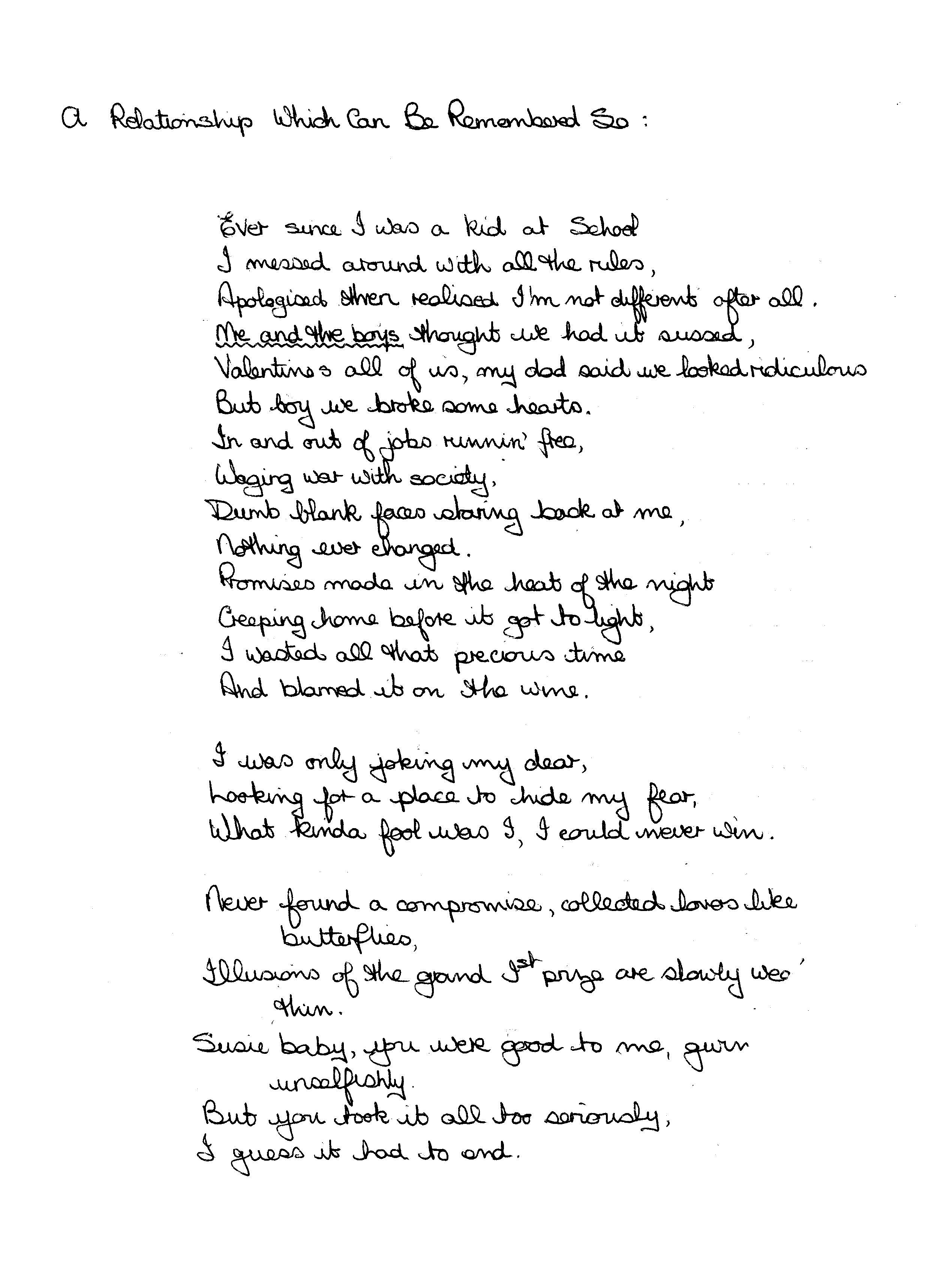
Before I go, a bit of an embarrassing exposé of something else from Alyson’s Archive (my box of teenage memorabilia). When “Foot Loose & Fancy Free” was released, one of the songs on it really summed up what I have been trying to recount above. I took to “pouring my heart out”, not in song, but in my 1978 diary. Yes, those boys with the aura, had a lot to answer for. I give you my hand-written lyrics to I Was Only Joking from January 1978. I laugh when I read the heading now, as to be honest, there never was a “relationship”, it was all in my head!

img084

I Was Only Joking by Rod Stewart:

Rod gets a lot of flak for that late ’70s phase of his career, but the two featured songs here show he was a master story-teller. I Was Only Joking is a tale of regret and of the care-free minds of the young. As such, it has become one of Stewart’s best loved songs and it contains one of the best guitar solos in classic rock. Rod co-wrote it with guitarist Gary Grainger. The Susie alluded to in the song was Susannah Boffey, who met Rod in 1961 when she was a 17-year-old art student. In 1963 she gave birth to a daughter, who was fostered out and eventually adopted by a wealthy couple. In 2010 however, Sarah Streeter was finally admitted to her father’s family.

Enough confessionals for today, and time to move onto another theme I think for next week or else Rol will think I’m being a bit weird, stalking his blog for ideas. Plenty more ideas out there, just sadly not always enough time for them all.

Until next week…

The Killing Of Georgie (Part I And II)
(Song by Rod Stewart)

In these days of changing ways
So called liberated days
A story comes to mind of a friend of mine

Georgie boy was gay I guess
Nothin’ more or nothin’ less
The kindest guy I ever knew

His mother’s tears fell in vain
The afternoon George tried to explain
That he needed love like all the rest

Pa said there must be a mistake
How can my son not be straight
After all I’ve said and done for him

Leavin’ home on a Greyhound bus
Cast out by the ones he loves
A victim of these gay days it seems

Georgie went to New York town
Where he quickly settled down
And soon became the toast of the great white way

Accepted by Manhattan’s elite
In all the places that were chic
No party was complete without George

Along the boulevards he’d cruise
And all the old queens blew a fuse
Everybody loved Georgie boy

The last time I saw George alive
Was in the summer of seventy-five
He said he was in love I said I’m pleased

George attended the opening night
Of another Broadway hype
But split before the final curtain fell

Deciding to take a short cut home
Arm in arm they meant no wrong
A gentle breeze blew down Fifth Avenue

Out of a darkened side street came
A New Jersey gang with just one aim
To roll some innocent passer-by

There ensued a fearful fight
Screams rang out in the night
Georgie’s head hit a sidewalk cornerstone

A leather kid, a switchblade knife
He did not intend to take his life
He just pushed his luck a little too far that night

The sight of blood dispersed the gang
A crowd gathered, the police came
An ambulance screamed to a halt on Fifty-third and Third

Georgie’s life ended there
But I ask who really cares
George once said to me and I quote

He said “Never wait or hesitate
Get in kid, before it’s too late
You may never get another chance

‘Cos youth’s a mask but it don’t last
Live it long and live it fast”
Georgie was a friend of mine

Oh Georgie stay, don’t go away
Georgie please stay you take our breath away
Oh Georgie stay, don’t go away
Georgie please stay you take our breath away
Oh Georgie stay, don’t go away
Georgie, Georgie please stay you take our breath away
Oh Georgie stay